.png)
Laser Cutting Stainless Steel: Materials, Thickness and Design Considerations
From selecting the right stainless steel grade to understanding sheet thickness, precision and finishing, discover what matters when planning a stainless steel laser cutting project.
Stainless steel is widely used in modern manufacturing, architectural applications, commercial interiors and custom fabrication. Its strength, corrosion resistance and clean appearance make it a practical material for projects that require both functionality and visual appeal.
However, producing accurate stainless steel components requires more than simply cutting a sheet into a shape. Material grade, sheet thickness, laser power, cutting parameters and design specifications all influence the final result.
Stainless steel laser cutting uses a concentrated laser beam to create precise cuts with controlled dimensions. Understanding the process helps designers, engineers and businesses make better fabrication decisions.
In this guide, we explore the different stainless steel grades, thickness considerations, cutting quality, design requirements and common applications.
1. What Is Stainless Steel Laser Cutting?
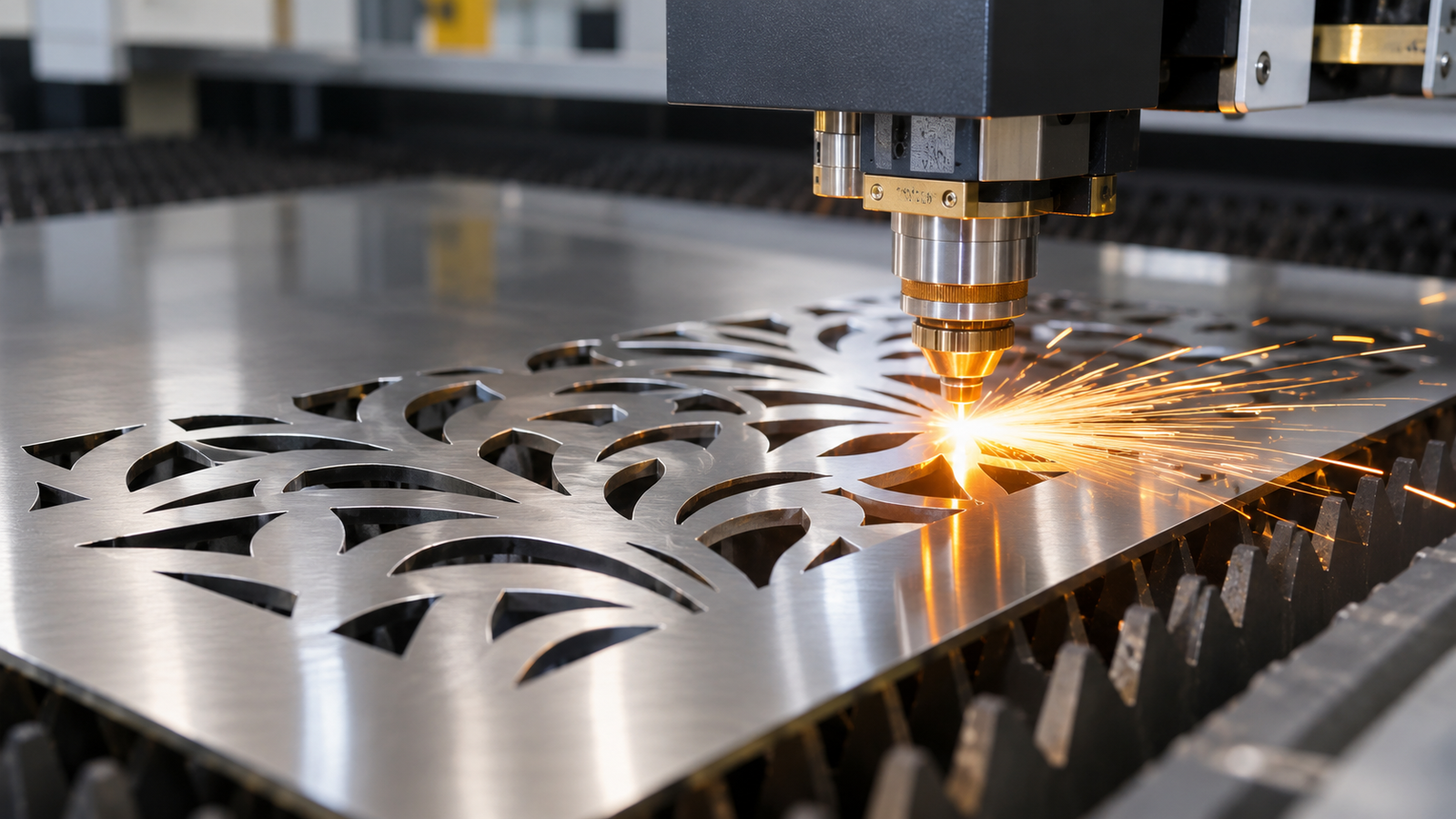
Precision laser cutting of a stainless steel sheet.
Stainless steel laser cutting is a thermal manufacturing process that uses a high-energy, focused laser beam to cut stainless steel sheets according to a digital design.
The laser heats a concentrated area of the metal while an assist gas helps remove molten material from the cutting path. This produces a cut based on the required shape and dimensions.
Modern fiber laser systems are widely used for stainless steel sheet processing because they offer precision, repeatability and efficient metal cutting capabilities.
Why is laser cutting used for stainless steel?
- Accurate cutting of complex shapes and profiles.
- Clean, controlled cutting paths.
- Consistent dimensions for repeated components.
- Ability to produce intricate patterns and cut-outs.
- Efficient processing of suitable sheet thicknesses.
- Reduced need for certain secondary cutting operations.
Important: Cutting precision and edge quality depend on machine configuration, material thickness, laser settings and assist gas selection.
2. Understanding Stainless Steel Grades
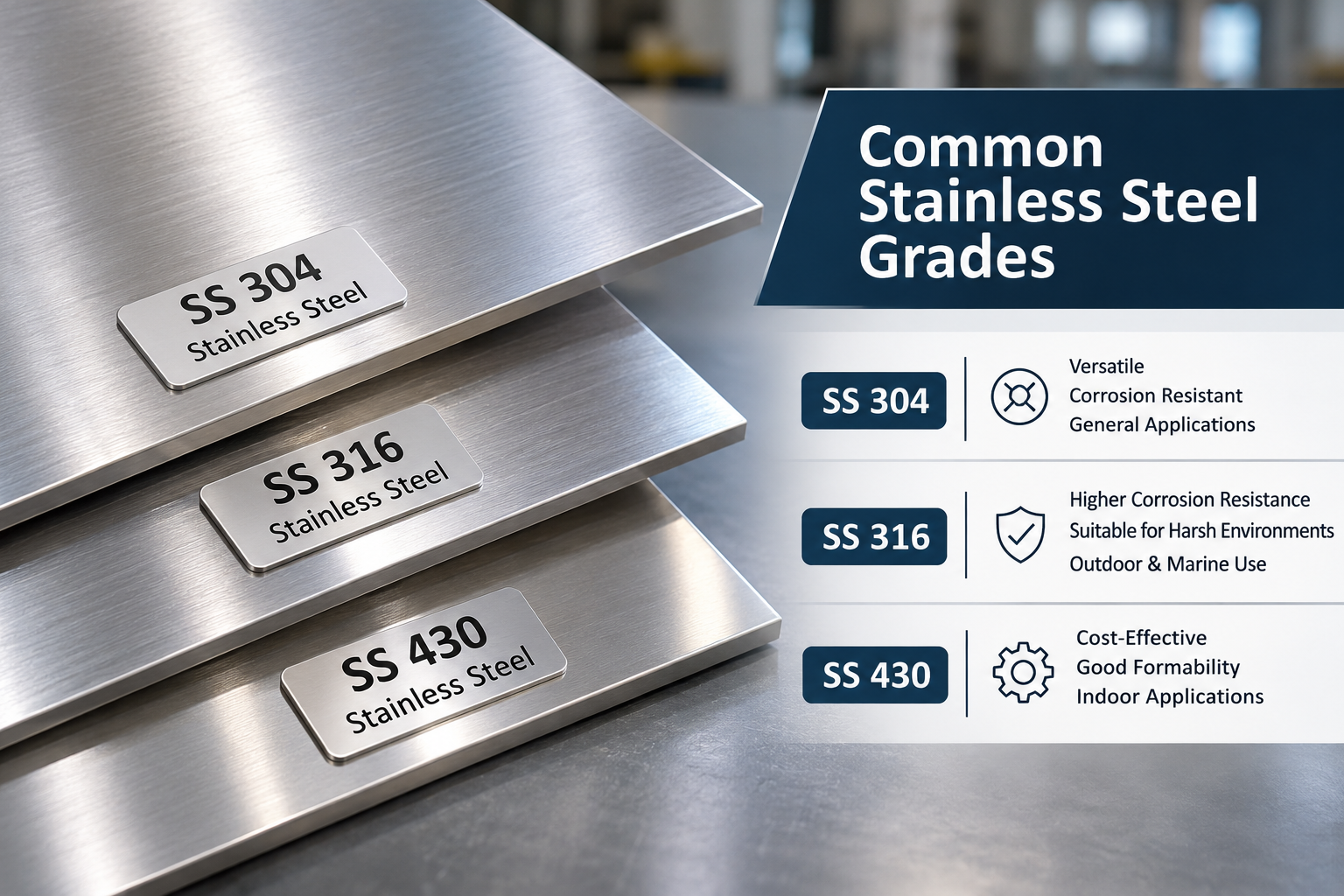
Stainless steel grades are selected according to application and environmental conditions.
Not all stainless steel is identical. Different grades have different chemical compositions, mechanical properties and corrosion resistance characteristics.
Selecting the correct grade is important because the material affects durability, appearance, fabrication requirements and long-term performance.
SS 304 Stainless Steel
Grade 304 is one of the most commonly used stainless steel grades. It offers good corrosion resistance, formability and versatility for general fabrication.
Common applications:
- Indoor decorative panels
- Commercial signage
- Kitchen equipment
- Architectural components
- General metal fabrication
SS 316 Stainless Steel
Grade 316 contains molybdenum, which improves corrosion resistance in many chloride-rich environments compared with grade 304.
Common applications:
- Coastal installations
- Marine-related applications
- Specialised industrial equipment
- Exterior architectural features
- Demanding environmental conditions
Which grade should you choose? SS 304 is suitable for many general-purpose applications, while SS 316 may be more appropriate where exposure to chlorides or corrosive conditions is a concern. The final choice should consider the installation environment and maintenance requirements.
3. Stainless Steel Thickness: What Should You Consider?
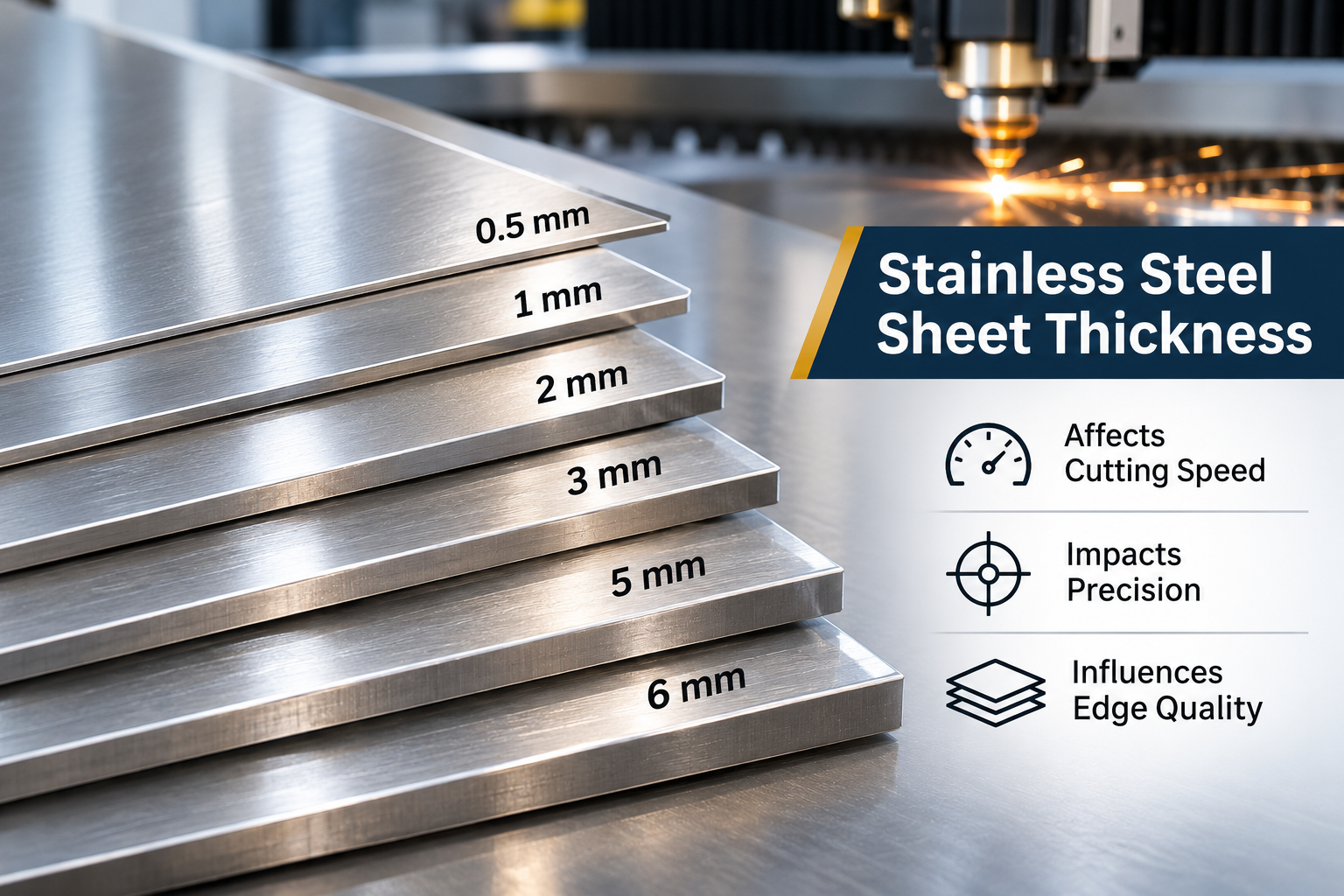
Sheet thickness influences cutting speed, precision and edge quality.
Sheet thickness is one of the most important factors when planning a stainless steel laser cutting project. It affects processing time, machine requirements, material handling and the final cutting result.
Thinner sheets are generally easier to process at higher speeds, while thicker sheets require suitable machine power and carefully controlled cutting parameters.
Common stainless steel sheet thickness categories
| Thickness | General Characteristics | Potential Applications |
|---|---|---|
| 0.5–1 mm | Thin sheet, lightweight and suitable for detailed work. | Decorative panels, covers and lightweight components. |
| 1–2 mm | Common sheet range for many light fabrication projects. | Signage components, enclosures and panels. |
| 2–3 mm | Offers additional rigidity for fabricated parts. | Architectural features, brackets and commercial components. |
| 3–6 mm | Requires suitable laser power and controlled processing. | Structural components, thicker panels and custom fabrication. |
| Above 6 mm | Machine capability and cutting parameters become particularly important. | Specialised metal fabrication and industrial components. |
These are general thickness categories, not guaranteed machine cutting limits. Actual processing capacity varies according to laser power, machine specifications, stainless steel grade, assist gas and required edge quality.
How thickness affects the cutting process
- Cutting speed: Thicker sheets generally require slower processing speeds.
- Laser power: Higher thickness may require greater available laser power.
- Edge quality: Incorrect settings can create rough edges, dross or excessive heat effects.
- Material handling: Heavier sheets require appropriate handling and support.
- Production cost: Processing time and material requirements influence the final cost.
4. Design Considerations Before Laser Cutting
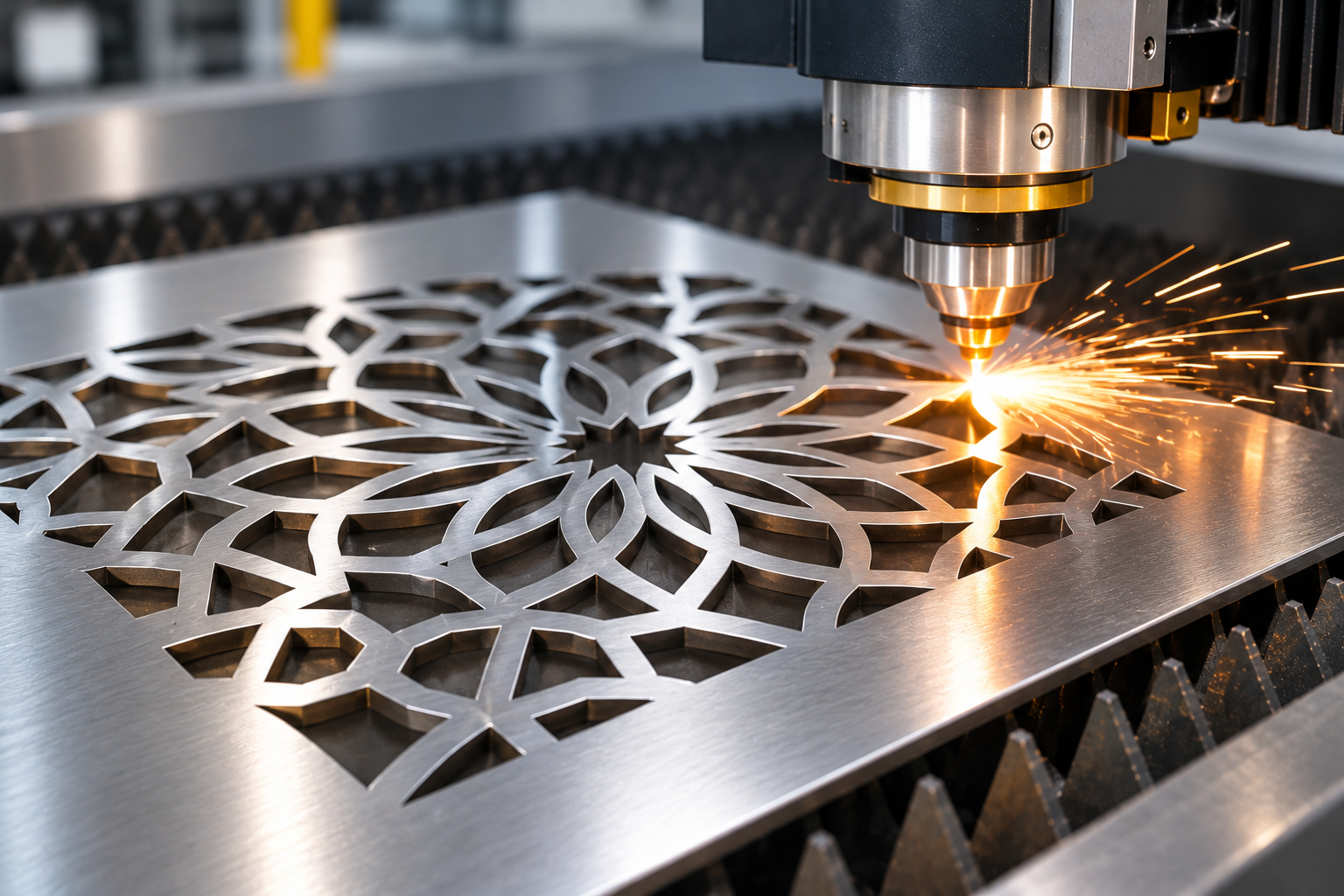
Design preparation plays an important role in accurate metal laser cutting.
A well-prepared design helps achieve accurate dimensions, consistent results and efficient material utilisation. Before sending a design for stainless steel laser cutting, several technical details should be reviewed.
1. Material thickness and design dimensions
Ensure that the design dimensions are suitable for the selected sheet thickness. Small openings, narrow sections and fine details may require adjustments depending on the material and machine capability.
2. Minimum feature size
Very small holes, narrow slots and delicate patterns can be challenging to cut in thicker materials. Feature dimensions should be evaluated in relation to the sheet thickness and cutting process.
3. Kerf width
Kerf refers to the material removed during cutting. It is an important consideration when designing components that require close dimensional tolerances or precise fitting.
4. Internal corners and sharp details
Extremely sharp internal corners can create stress concentrations or fabrication challenges. Depending on the application, small radii may improve the practicality of the design.
5. File format and drawing preparation
Digital vector drawings help communicate the intended cutting geometry. Suitable file formats and clearly defined dimensions make production preparation easier.
- DXF files for CAD-based cutting geometry.
- DWG drawings for technical design information.
- AI or other vector artwork for suitable design workflows.
- Clearly defined dimensions and units.
- Closed paths and properly prepared cutting outlines.
Design tip: Always discuss minimum feature sizes, tolerances and material thickness with the fabrication team before finalising detailed cutting drawings.
5. What Determines Stainless Steel Laser Cutting Quality?
Two stainless steel components may be cut from the same grade and thickness but produce different results. This is because cutting quality depends on several connected process variables.
Laser Power
The available laser power must be appropriate for the material grade and thickness being processed.
Assist Gas
Gas selection and pressure influence molten material removal, oxidation and edge quality.
Cutting Speed
Incorrect cutting speed can contribute to rough edges, incomplete cuts and excessive heat input.
Focus Position
Proper laser focus is important for maintaining an effective energy concentration throughout the cut.
Material Quality
Sheet condition, surface quality and material consistency can influence the cutting outcome.
Machine Condition
Equipment calibration, optics and maintenance contribute to reliable and repeatable production.
6. Surface Finishing After Laser Cutting
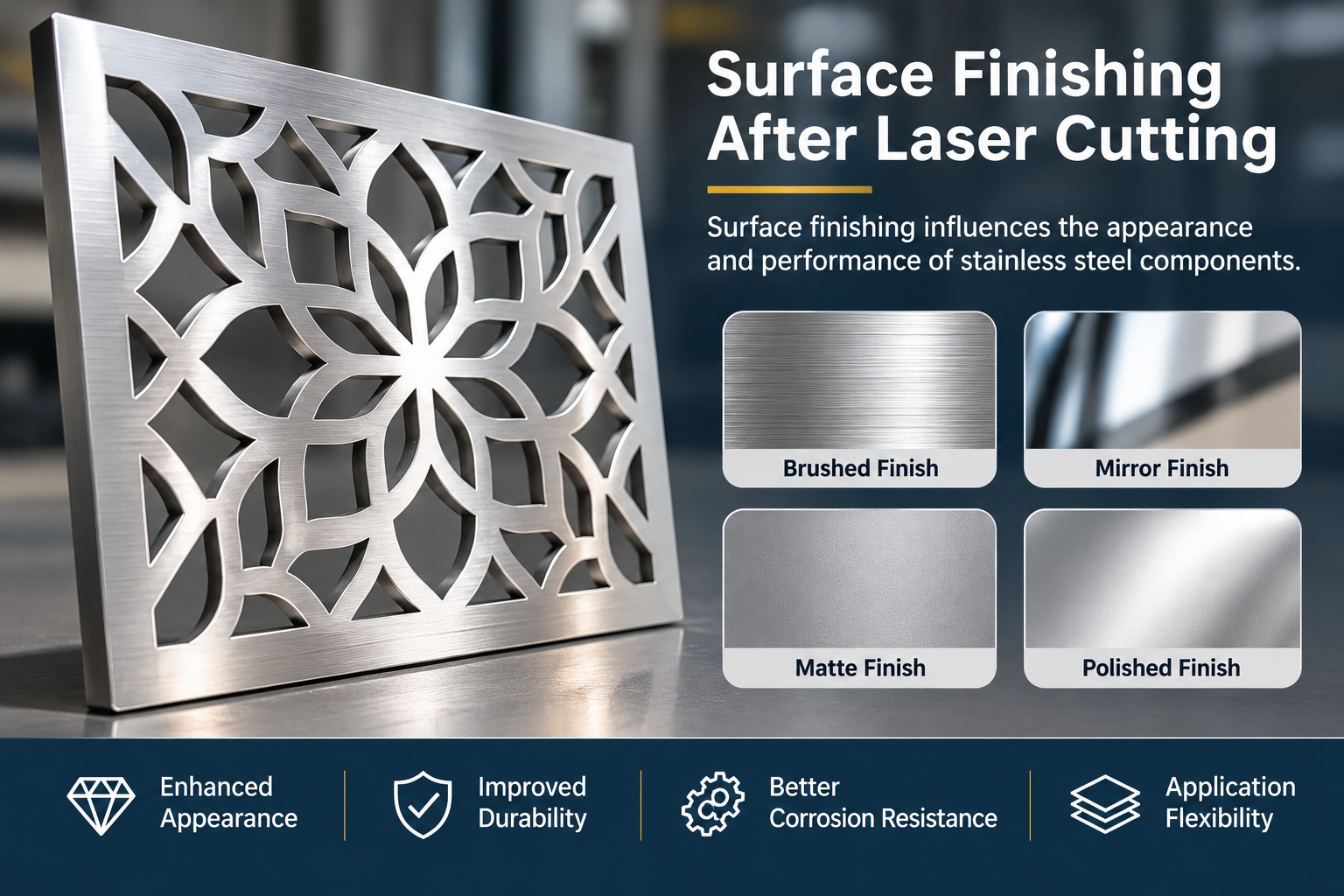 Surface finishing influences the appearance and performance of stainless steel components.
Cutting is only one part of the fabrication process. Depending on the application, stainless steel components may require additional finishing to achieve the desired appearance and functional performance.
Common stainless steel finishes
- Brushed finish: Creates a directional texture commonly used in architectural and decorative applications.
- Mirror finish: Provides a highly reflective surface for selected decorative and architectural projects.
- Matte finish: Offers a less reflective appearance for modern commercial and industrial applications.
- Polished finish: Improves the surface appearance through appropriate mechanical finishing processes.
Depending on the application and cutting process, additional operations such as deburring, edge cleaning, polishing or suitable passivation may be required.
Remember: Surface finishing should be considered during the design stage, not only after cutting is completed.
7. Applications of Laser-Cut Stainless Steel

Laser-cut stainless steel supports a wide range of architectural and commercial applications.
The combination of precision, durability and design flexibility makes stainless steel laser cutting suitable for various commercial, architectural and industrial applications.
Common applications include:
- Architectural metal panels: Decorative panels, screens and custom architectural features.
- Commercial signage: Metal lettering, logo elements and custom sign components.
- Interior design: Decorative partitions, feature panels and custom metal details.
- Retail displays: Custom display components and branded metal structures.
- Industrial fabrication: Enclosures, brackets, covers and equipment components.
- Custom fabrication: Bespoke metal shapes, patterns and project-specific components.
8. Common Mistakes to Avoid in Stainless Steel Laser Cutting
Many fabrication problems can be reduced through proper material selection, design preparation and communication before production.
- Choosing the wrong grade: Selecting material without considering its environment can affect long-term corrosion resistance.
- Ignoring sheet thickness: Design details may not be suitable for the selected material thickness.
- Using poorly prepared drawings: Open paths, unclear dimensions and duplicate outlines can create production issues.
- Ignoring finishing requirements: The cutting process alone may not deliver the final surface appearance required.
- Overlooking tolerances: Components designed for assembly may require specific dimensional allowances.
- Prioritising price over specifications: Material grade, cutting quality and finishing should be evaluated alongside project cost.
9. Stainless Steel Laser Cutting for Signage and Fabrication in Abu Dhabi
Stainless steel is an important material in modern commercial signage, architectural branding and custom fabrication. Its appearance and durability make it suitable for a variety of indoor and outdoor applications.
At Arch And Art, our fabrication and signage solutions include custom metal work, acrylic fabrication, laser cutting, UV printing and digital printing.
Stainless steel components can be incorporated into projects such as:
- Custom metal signage and lettering.
- Decorative architectural panels.
- Corporate branding elements.
- Custom-fabricated sign components.
- Commercial display and interior branding projects.
Choosing the right material, thickness, design and finishing approach is essential for achieving a result that meets the project's requirements.
If you are planning a stainless steel cutting, signage or custom fabrication project, discuss your specifications with our team.
Explore our signage solutions and acrylic fabrication services .
10. Checklist Before Starting Your Project
Before sending your stainless steel design for production, make sure you have reviewed these essential details.
- Have you selected the appropriate stainless steel grade?
- Is the sheet thickness suitable for the application?
- Are the design dimensions clearly specified?
- Have minimum feature sizes been reviewed?
- Are the cutting tolerances defined?
- Have the finishing requirements been confirmed?
- Has machine compatibility been verified?
- Are the production quantity and delivery requirements clear?
Planning a Stainless Steel Laser Cutting Project?
Whether you need custom metal components, decorative panels, signage elements or fabrication support, Arch And Art can help you discuss the right specifications for your project.
Discuss Your Project on WhatsApp Visit Our WebsiteFrequently Asked Questions
1. What is stainless steel laser cutting?
Stainless steel laser cutting uses a focused laser beam to cut stainless steel sheets into specific shapes and dimensions with controlled precision.
2. Which stainless steel grades can be laser cut?
Common grades include SS 304 and SS 316. Other grades may also be suitable depending on their composition, thickness and machine capability.
3. What thickness of stainless steel can be laser cut?
The suitable thickness depends on the laser power, machine configuration, material grade and required cutting quality. Confirm the processing limits with your fabrication provider.
4. What is the difference between SS 304 and SS 316?
Both are austenitic stainless steel grades. SS 316 contains molybdenum, offering improved corrosion resistance in many chloride-rich environments compared with SS 304.
5. Does laser cutting stainless steel cause rust?
Laser cutting does not automatically cause rust. However, contamination, heat effects, improper finishing and environmental exposure can affect corrosion resistance.
6. What affects stainless steel laser cutting precision?
Material grade, sheet thickness, laser power, cutting speed, focus position, assist gas, machine condition and design geometry all influence precision.
7. What are the applications of laser-cut stainless steel?
Applications include custom signage, decorative panels, architectural features, metal enclosures, commercial displays and industrial components.
8. Is stainless steel suitable for outdoor signage?
Yes. Suitable stainless steel grades can be used for outdoor signage. The grade, finish, installation environment and maintenance requirements should be considered before selection.